As much as I like Elizabeth and the general story of Bioshock: Infinite, I also think that it is a cowardly political game that tries to be about Big Things and Mature Themes. However, in place of maturity, it decides to fall on its face and show its whole ass when things come to a head and the ur-fascist regime comes crashing down.
For those who haven’t played the game: The game is set in Columbia, a city in the clouds rooted in turn-of-the-century science fiction concepts, with an aesthetic inspired heavily by Gilded Age Americana and especially the 1893 World’s Columbian Exposition. The city seceded from the Union after it wiped out Beijing during the Eight-Nation Alliance/Yihetuan Movement war (usually called the Boxer Rebellion in the West).
By 1912, when the game takes place, it’s firmly under the thumb of a white supremacist party called the Founders, with popular resistance of the people abducted and enslaved to fuel its economy taking the form of the loosely organized Vox Populi. You’re smack right in the middle of the story as Booker DeWitt, shellshocked former cavalryman turned private eye, sent to the city to recover a girl in order to get rid of your horse racing debts.
It’s a hard-boiled narrative that has a lot of twists and turns. The girl turns out to be more than Booker expected, there’s a lot of explosions, dimensional traveling, time warps, and politics.
Oh god, the politics.
The Setup
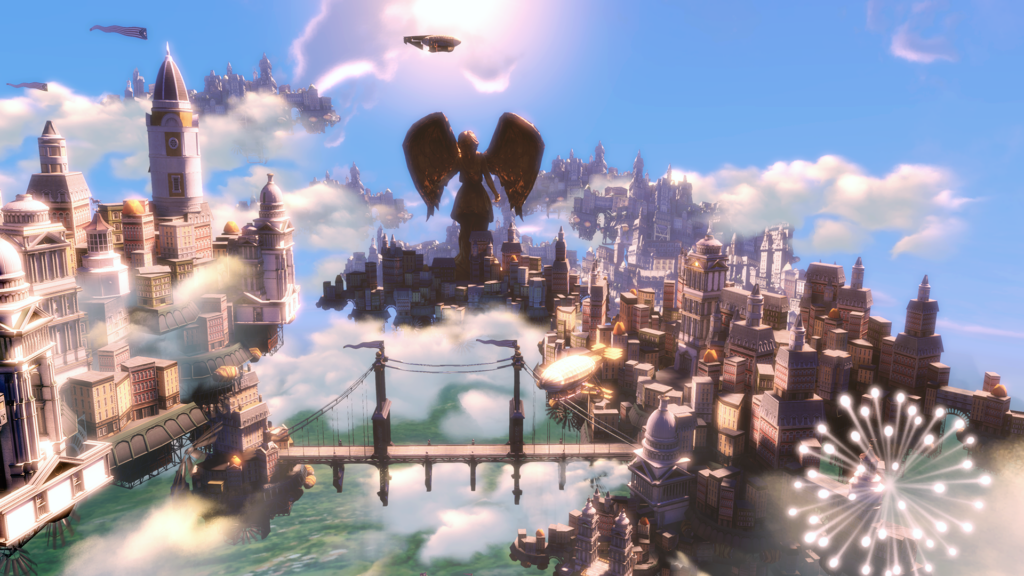
Columbia is a great place to live – if you happen to be a white, Anglo-Saxon Christian with conservative politics. For everyone else, the gilded veneer of politness gives way to the brutal reality: The city state is a racist tyranny, ruled by a Christofascist, white elite brutally exploiting the disenfranchised masses that immigrated into the city or – in the case of anyone non-white – were abducted and enslaved.
We’re not simply told about it: We’re explicitly shown how Columbia brutalizes people. From the very start it’s an explicitly jingoist culture where racism is revered as a virtue, antisemitism is prevalent, and genocide is a show of strength and pride. Quite literally, in fact: The event that brought about Columbia’s secession from the United States was the destruction of Beijing in 1900. A city estimated at 750,000 citizens at the end of the 19th century, making it one of the largest in the world at the time, wiped out because thirty of Columbia’s goose-stepping stormtroopers were killed. Same logic as the Nazis massacring the innocent Czechs in Lidice in retaliation for the death of one of their main power players.
The event is enshrined together with the slaughter of native Americans at Wounded Knee as the founding mythos of the city state, with an entire level taking place in the exhibitions devoted to lionizing Comstock, the leader of the city, as a messianic figure conquering foreign hordes.
It doesn’t stop there: In subsequent levels we explore the dungeons of Columbia, where undesirables are tortured, vivisected, and executed; we listen to Comstock’s unhinged racist rants on how the lesser races should all learn to serve the white man like dogs; experience first hand the exploited, starved slums full of people ruthlessly exploited by capitalists like Fink – and eventually we dimension-hop into a reality where we helped ignite an uprising.
Here comes the centrism
Good stories would use this opportunity to dwell on the way such horrific violence creates a backlash, how the downtrodden and abused people who suffered for years under violent occupation will give no quarter, for they were given none – and, without judgment, ponder if we can truly sit in judgment of the people who rise up.
For a moment, Bioshock Infinite does just that: We witness the people rising up, the Founders executed in the streets right next to the stocks where the poor who stole a loaf of bread to feed their starving kids were once imprisoned. We rush the gates of Fink’s factory to take down his regime, built on the blood and bones of the common man.
For a moment the game dares to take a side.
Then it becomes… You know what, let’s quote Ken Levine on the topic, from his PC Gamer interview:
If [Bioshock Games are] about anything they’re about not buying into a single point of view. About having a lack of confidence in anything. They’re not ever an attack on a single idea. It’s a bit of a plague on all your houses. The American experiment is insanely successful and positive.
In classic centrist fashion mandated by the auteur, after finally seeing the downtrodden rise up against what’s basically the American Nazi Party, players are forced to fight the Vox Populi: Their black leader, Daisy Fitzroy, orders Booker killed, because he “complicates the narrative” by coming back from the dead in a timeline where he is a martyr to the revolution.
Then she tries to kill Fink’s son, to end his bloodline and claim to Columbia. Then you spend another several hours fighting the Vox, as the game turns from a sobering exploration of nationalism and zealotry into a snuff film that unintentionally justifies the Founders’ brutality by showing, in exquisite detail, how the non-white militia really is just a brutal, unwashed horde that will rape and pillage Columbia given the chance.
It’s the same rhetoric used by high-profile Nazis like Hans-Ulrich Rudel, a Stuka pilot whose memoirs include horrifyingly racist descriptions of Slavic peoples and justification of Nazi atrocities as “defense of Christianity”.
Fun fact: These memoirs were mandatory reading for designers of the A-10 CAS plane – hopefully just for the breakdown of his CAS duties on the Eastern Front.
High-grade bullshit
This centrist logic of both-sides-are-extreme-therefore-both-are-wrong is moral myopia at its finest. After showing in exquisite detail how Columbia is really a horrific, oppressive state suffused by racism at every level, it turns around and casts these violent racists as victims. Consequences come for people who, for nearly twenty years, reaped the benefits and directly profited from the systematic abduction, enslavement, and murder of their “lessers.”
Vox Populi is evil because they react to twenty years of abuse and systematic exploitation with violence. Daisy Fitzroy is evil, because after killing Fink, she wants to finish the job by killing his son, after Fink and the founders killed countless children, men, and women through starvation, forced labor, and systemic murder.
The writers ask you to feel sorry for people who thought genocide is a good idea, throwing horrific violence in your face – including scalping prominent Columbians – without contextualizing it or pondering just why the violence happens.
It’s reminiscent of Nazi propaganda before, during, and especially after World War II. The tall tales of persecution told by Germans living in Poland, inflated during the war and occupation – such as the claim of 58,000 Volksdeutsche civilians killed by Poles in September 1939, inflated tenfold and only completely corrected in 1969 by Karol Pospieszalski – and the decades-long whitewashing of Nazi atrocities afterwards.
In this propaganda, the roles of the victim and the abuser are swapped by removing any and all context. Retaliation by Slavs against Germans becomes an unprovoked atrocity by barbarians, rather than backlash resulting from a genocidal war that left tens of millions dead in Eastern Europe: Six million in Poland alone, including 90% of Jewish Poles. The Reich spent six years exploiting, enslaving, and exterminating on an unprecedented scale, from deliberately starving people at a mass scale, through creating a mass slavery system that affected some twenty million (over five times as many as the southern states at their peak), to systematic mass slaughter of undesirables that consumed tens of millions of lives.
Then, when defeated, these sadistic monsters turned around and started whining that their bestial brutality and incredible levels of degenerate violence have not resulted in the survivors of their atrocities showing superhuman levels of restraint and kindness. That, for example, the infamous 7. SS-Gebirgsdivision “Prinz Eugen” responsible for unthinkable atrocities including mass killings of children, was wiped out in mass executions without trial. Soldiers went against Tito’s orders, risking court martial to get justice for the deaths of their families.
There is no equivalence between the abused and the abuser.
The rape victim is not the same as the rapist.
Pearl-clutching
Yet that is essentially the argument made by Bioshock Infinite. The brutalized people, relegated to a permanent underclass, living for years under the threat of violence, rape, and murder, are forbidden from retaliation. The perpetrators, who personally harmed, tortured, and killed, can do so without fear of consequence, as to lash out against them means you’re exactly the same as them.
And that means you can kill them all. The game will let you loose on the victims of this systemic violence, murdering them for the crime of not showing superhuman levels of restraint and immediately following a revolution with a perfect system of governance, where everyone is treated fairly, we all sit together and sing songs, and nobody ever gets hurt.
In fact, the narrative decision was so bad, so out-of-character, that Irrational later explicitly walked it back and retconned it in Fanservice Burial at Sea: Daisy Fitzroy isn’t actually turning on Booker, she was just coerced by the Lutece Twins to provoke Elizabeth into killing her and push her character arc along.
I’m not sure what’s worse: The impossibly centrist attitude of making a black woman leading a popular uprising a backstabbing villain, because power corrupts everyone and ideals are silly – or turning her into a prop without agency, existing only to push along a white woman’s arc.
Final thoughts
Bioshock Infinite is a game I still have a soft spot for thanks to its gameplay, but I no longer appreciate its story. Back in 2013 it was revolutionary, a game that tackles Big Themes and tries to be profound, and tries to be art.
Tries is the operative word. It tries and fails, as it ultimately says nothing beyond trying to both-side oppression, with exploration of racism limited to providing a thinly-veiled excuse for gunning down the Founders without soiling your conscience. Reappraisals of Infinite are much more critical of its narrative and themes (shout out to Stacey Henley).
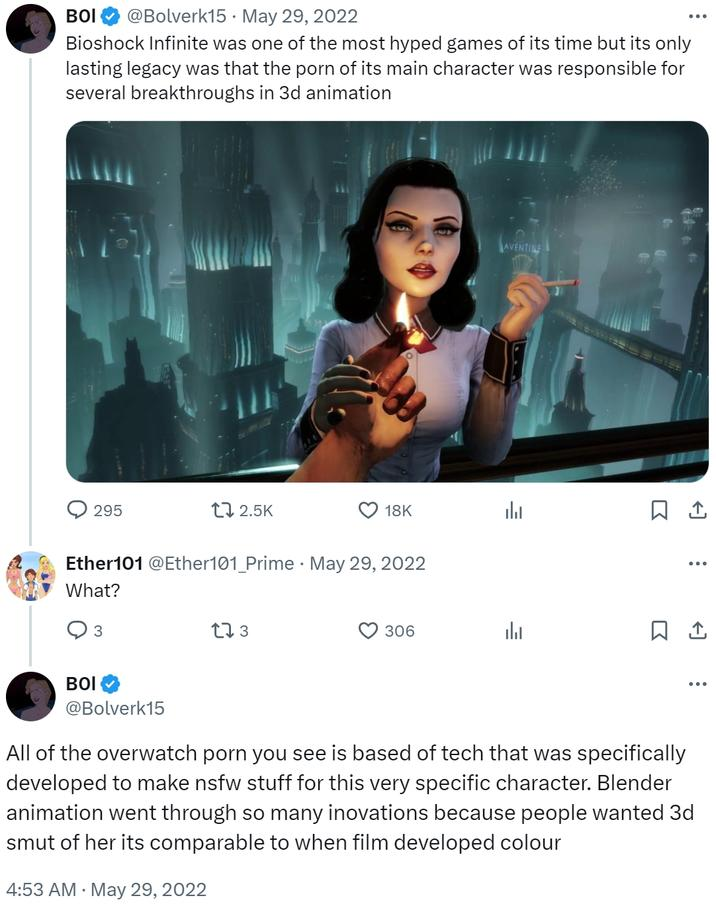
However, I think that a much more summary of Infinite‘s lasting legacy is the meme that spurred this little article:
Leave a Reply